
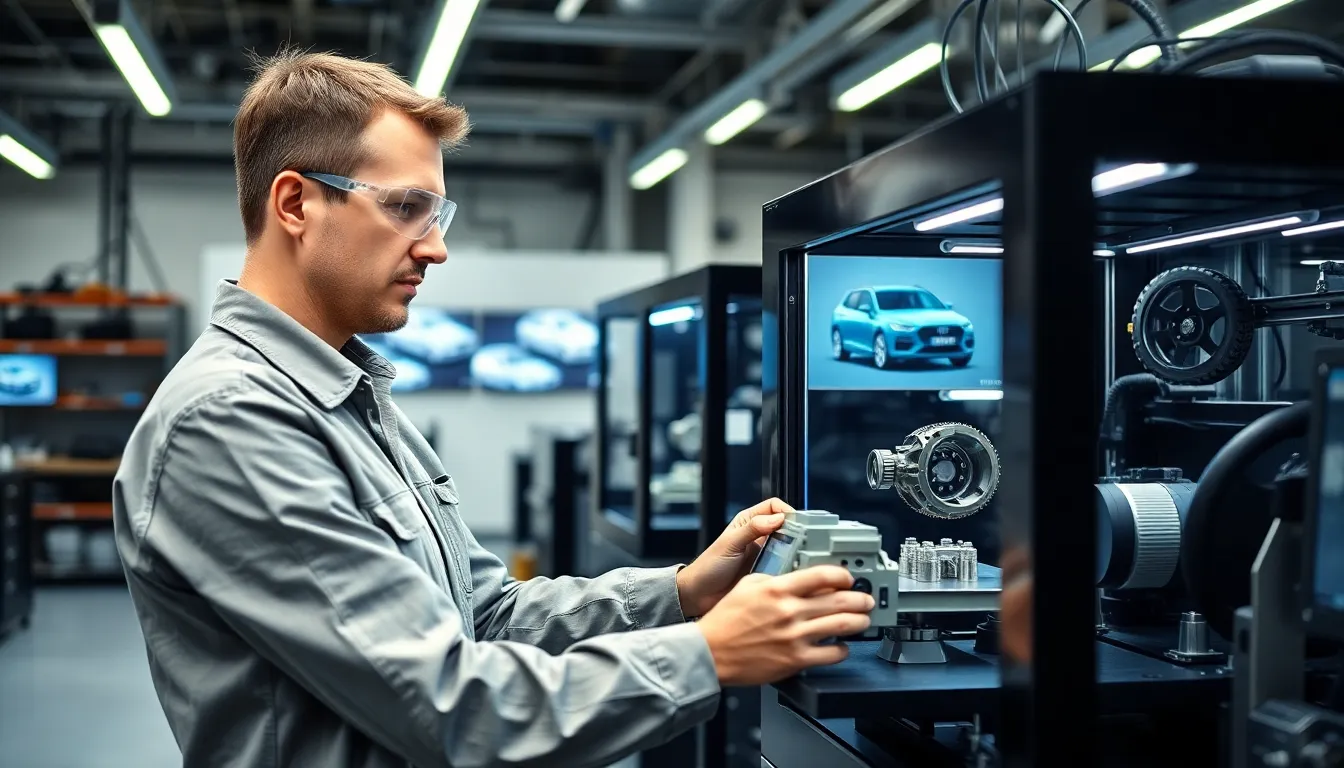
The automotive industry is revving up like never before, and 3D printing is the turbo boost it never knew it needed. Imagine cars that can be customized on the fly, parts produced faster than you can say “assembly line,” and designs that defy traditional manufacturing limits. Sounds like science fiction? It’s happening right now, and it’s transforming the way vehicles are made.
Overview of 3D Printing in Automotive Industry
3D printing revolutionizes the automotive industry by enabling rapid prototyping and production. This technology streamlines design processes, allowing manufacturers to produce parts in days rather than weeks. Customization options become virtually limitless through 3D printing. Vehicles can now incorporate unique components that cater to specific consumer needs.
Manufacturers utilize various materials, such as plastics, metals, and composites, to create parts. Certain companies have reported reduced manufacturing costs by as much as 30% with additive manufacturing techniques. Significant advancements in metal 3D printing boost production capabilities, allowing for lightweight and high-strength components.
Utilization of 3D printing enhances supply chain flexibility. It enables manufacturers to produce components on-demand, reducing the need for extensive inventory. Automated and smart factories leverage this technology to optimize workflows and inventory management.
Electrification in vehicles benefits from 3D printing, as it supports the development of innovative battery designs. Efficiency gains in production processes lead to shorter lead times for electric vehicle components. Sustainability emerges through resource optimization, minimizing waste and energy consumption.
Collaborations between automotive giants and startups drive innovations in 3D printing. Global investment in this technology signals a commitment to shaping the future of transportation. Real-world applications and success stories showcase the potential for 3D printing to not only change how vehicles are made but also enhance performance and design.
Applications of 3D Printing
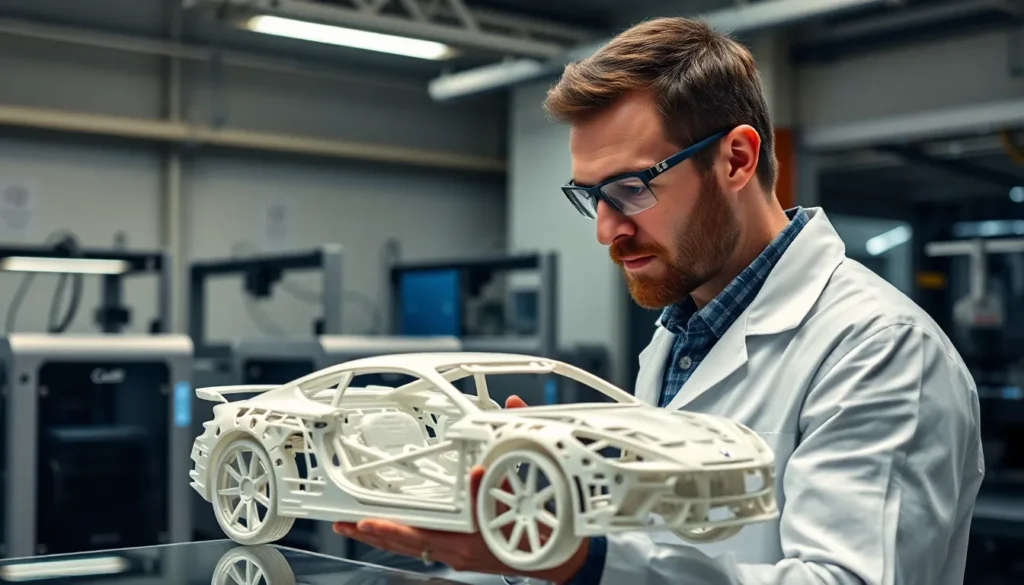
3D printing is transforming the automotive industry with diverse applications that enhance both design and production processes.
Prototyping and Design
Prototyping simplifies the creation of complex designs, allowing for rapid iteration. With this technology, engineers can quickly test and refine components, reducing development times significantly. Designers leverage digital models to create accurate prototypes, ensuring precise fit and function before full-scale production begins. Companies report substantial time savings during testing phases, sometimes cutting weeks from traditional methods. Enhanced creativity emerges as designers explore innovative shapes and structures impossible with conventional manufacturing techniques. This approach not only optimizes product performance but also enriches aesthetic appeal, leading to unique vehicle offerings in the market.
Production Parts
Production parts benefit from the efficiency of 3D printing by allowing on-demand manufacturing. Automotive manufacturers can produce custom components that meet specific consumer needs, minimizing waste and reducing costs. With the ability to fabricate parts using various materials, including durable metals and lightweight plastics, performance improves across vehicle models. Some companies experience a reduction in lead times by as much as 70%, enabling faster assembly lines. On-site production capabilities streamline supply chains, decreasing reliance on extensive inventories. This flexibility empowers manufacturers to respond quickly to market demands, ensuring that innovation keeps pace with consumer expectations.
Benefits of 3D Printing in Automotive
3D printing provides numerous advantages within the automotive industry, including cost efficiency and unrivaled customization.
Cost Efficiency
Significant savings occur in manufacturing costs through 3D printing. Companies report reductions of up to 30% thanks to additive manufacturing techniques. With this process, on-demand production minimizes waste, resulting in lower material costs. Production timelines shrink considerably, leading to a reduction in lead times by as much as 70%. Decreasing lead times enables faster assembly and improved supply chain management. Parts become available much quicker, enhancing overall operational efficiency. By streamlining workflows and reducing reliance on extensive inventories, automotive manufacturers experience increased profitability.
Customization
Customization options expand remarkably with 3D printing. Unique vehicle models develop to meet specific consumer preferences, enabling manufacturers to cater to niche markets. Designers create complex shapes and detailed features that traditional methods cannot achieve easily. In addition, engineers modify parts seamlessly through digital models. Various materials, including plastics and metals, allow for a diverse range of applications. Personalization not only enhances user satisfaction but also promotes brand loyalty. As a result, vehicles evolve into highly customizable products that reflect individual tastes, setting manufacturers apart in a competitive landscape.
Challenges in Adoption
3D printing in the automotive industry faces several challenges that hinder widespread adoption. These obstacles complicate the path to integrating this innovative technology fully into manufacturing processes.
Material Limitations
Current materials available for 3D printing restrict performance in certain automotive applications. Designers often seek high-strength materials able to withstand rigorous conditions, yet not all additive materials offer the necessary durability and heat resistance. Some manufacturers struggle to find suitable options, leading to hesitations in adopting 3D printing for critical components. Technological advancements are ongoing, but achieving the required material properties remains a key hurdle for many automotive firms.
Regulatory Hurdles
Navigating the regulatory landscape presents a significant challenge for the automotive sector’s adoption of 3D printing. Compliance with safety and quality standards adds complexity to the integration process, often resulting in lengthy approval timelines. Authorities may lack established guidelines specifically for 3D-printed parts, creating uncertainty around accountability and responsibility. Automotive manufacturers face pressures to prove that printed components meet rigorous standards, complicating efforts to incorporate this technology efficiently. Increased dialogue between industry players and regulatory bodies may foster better understanding and streamlined processes.
Future Trends in 3D Printing for Automotive
The automotive industry is on the brink of transformative changes due to evolving 3D printing technologies. Innovations in this arena promise to deliver unprecedented capabilities for vehicle design and production.
Advancements in Technology
Next-generation 3D printing technologies enable more complex geometries and enhanced material properties. Speed becomes a crucial factor, as new printing methods reduce prototype development time significantly. Increased adoption of metal printing expands the possibilities for producing durable components. Advanced software tools streamline the design process, allowing engineers to optimize parts and enhance performance. Integration with robotics facilitates greater precision and efficiency in production. As intelligent factories emerge, workflow automation paired with additive manufacturing minimizes errors and maximizes output.
Sustainable Practices
Sustainability continues to influence 3D printing in the automotive sector. It reduces waste significantly by utilizing only the required materials during the manufacturing process. Companies increasingly explore bio-based and recyclable materials, aligning with eco-friendly initiatives. By leveraging local production methods, manufacturers decrease transportation emissions while meeting consumer demands. Energy-efficient printing processes also contribute to lowering the carbon footprint associated with vehicle production. Collaborative efforts between automotive manufacturers and material innovators help create solutions that prioritize sustainability and long-term viability.
The automotive industry’s embrace of 3D printing marks a pivotal shift towards innovation and efficiency. As manufacturers continue to explore the technology’s vast potential, the ability to produce customized parts on demand is reshaping market dynamics.
Sustainability remains a key focus as 3D printing minimizes waste and energy consumption. The collaboration between established companies and startups fuels further advancements, ensuring that the industry stays at the forefront of technological progress.
While challenges exist, such as material limitations and regulatory hurdles, the ongoing dialogue within the industry is paving the way for future solutions. As 3D printing technologies evolve, they promise to redefine vehicle manufacturing, enhancing performance, design, and sustainability for years to come.