

In a world where imagination meets technology, 3D printing has emerged as the wizardry of modern manufacturing. Gone are the days of waiting for a product to be made; now, it’s all about hitting “print” and watching your ideas materialize right before your eyes. But who’s behind this magical transformation? Meet the biggest players in the 3D printing arena, companies that are not just printing objects but also reshaping industries and redefining creativity.
Overview of 3D Printing Industry
3D printing represents a rapidly evolving sector within manufacturing. This technology enables the creation of three-dimensional objects from digital models, transforming the way products are designed and produced. Various industries leverage 3D printing, leading to innovations in automotive, aerospace, healthcare, and consumer goods.
Companies like Stratasys and 3D Systems dominate the market, offering advanced printers and materials. Stratasys specializes in FDM and PolyJet technologies, pushing the boundaries of prototyping. Meanwhile, 3D Systems focuses on diverse applications, ranging from rapid prototyping to complex end-use parts.
Growth statistics reflect the industry’s trajectory. The global 3D printing market size was valued at $15.5 billion in 2020, projected to reach $34.8 billion by 2026, with a CAGR of 14.5%. Demand for custom products fuels expansion, allowing businesses to reduce waste and enhance efficiency.
Sustainability is a growing concern, and companies are exploring eco-friendly materials. Biodegradable plastics and recyclable filaments emerge as viable alternatives, embodying a commitment to environmental responsibility.
Investments in R&D drive innovation further, leading to enhanced materials and technology capabilities. Firms are exploring artificial intelligence for improved design processes. As collaboration between tech companies and manufacturers increases, new applications will likely emerge.
The market landscape includes emerging players with innovative solutions. Startups are introducing unique materials and specialized applications. This fosters competition, ultimately benefiting end users with more diverse offerings.
As the 3D printing industry evolves, it significantly influences global manufacturing practices. Businesses recognize the potential for customization and rapid prototyping, reshaping production methods.
Key Players in the Market
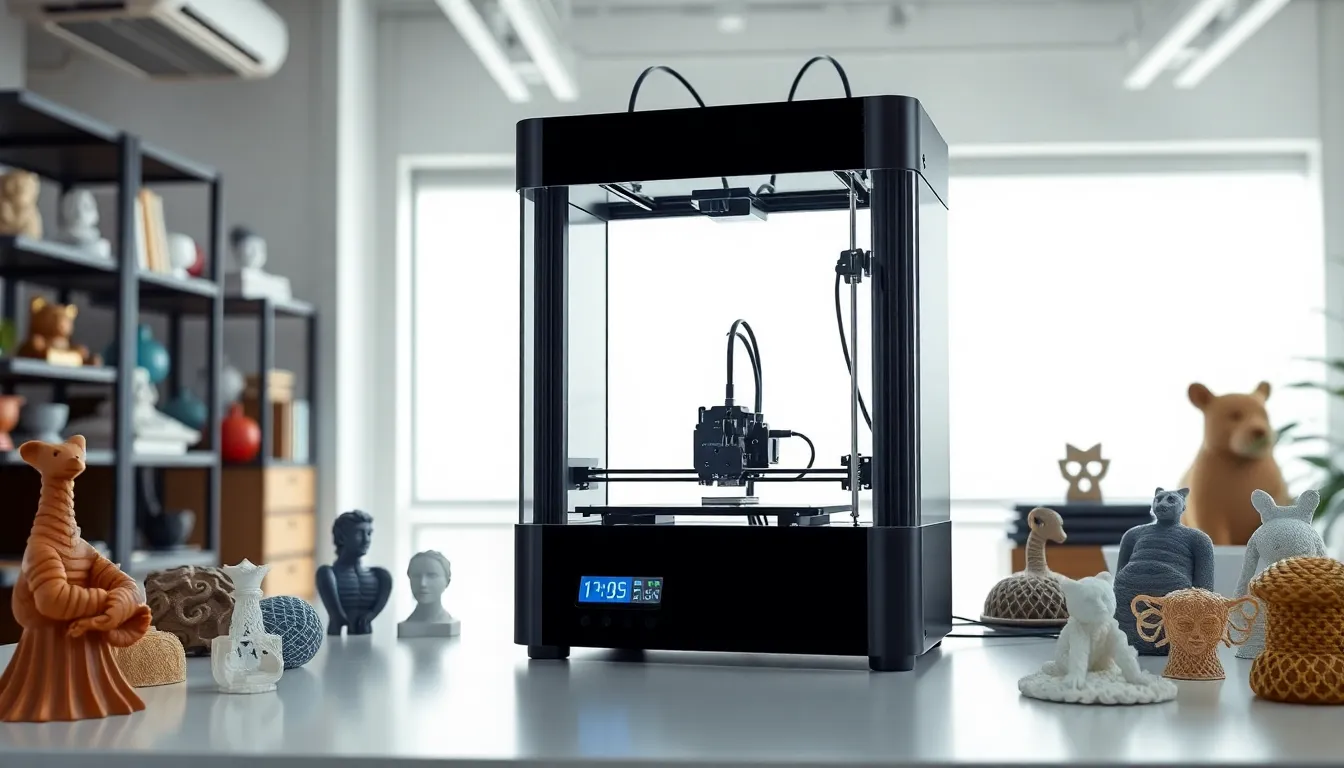
Several companies dominate the 3D printing landscape, showcasing diverse technologies and applications. These key players significantly influence the industry with their innovative solutions.
Company Profiles of Major Players
Stratasys remains a recognized leader in the sector, providing advanced solutions for prototype development. 3D Systems also stands out, offering a wide range of printers and materials tailored for multiple industries. HP has entered the market with its Multi Jet Fusion technology, pushing boundaries in production speed and quality. EOS specializes in industrial 3D printing systems focusing on metal and polymer materials, helping companies enhance manufacturing efficiency. Lastly, Ultimaker appeals to smaller businesses and educators with its user-friendly desktop printers, promoting widespread adoption of 3D printing.
Market Share Analysis
As of 2023, Stratasys maintains the largest market share, capturing approximately 30% of the global 3D printing market. 3D Systems closely follows, holding around 25% of market penetration. HP’s recent innovations have secured it roughly 15% of the market, while EOS and Ultimaker account for 10% and 8%, respectively. Emerging startups together represent about 12% of the market share, indicating a dynamic sector. Continuous investment in research and development by these companies drives growth and shapes competitive dynamics in the industry.
Innovations in 3D Printing Technologies
Innovations in 3D printing technologies significantly impact various industries, enhancing efficiency and creativity. The advancements in materials and software play crucial roles in this progression.
Advances in Materials
Innovative materials redefine possibilities in 3D printing. Biodegradable plastics enable eco-friendly production, meeting sustainability goals. Companies explore advanced polymers and metal composites that boost functionality. Stratasys leads in developing new thermoplastics suitable for aerospace applications, while HP focuses on multi-material solutions for consumer products. Enhanced materials improve product durability and reduce production costs. Data indicates that the adoption of specialty materials contributes to market growth, with significant demand from the automotive and healthcare sectors.
Software Developments
Software advancements streamline the design process. Sophisticated algorithms now facilitate faster and more precise modeling. Systems like Autodesk Fusion 360 allow for seamless integration with 3D printers, enabling users to create complex geometries effortlessly. Companies deploy artificial intelligence to optimize print settings, resulting in less waste and faster turnaround. Enhanced simulation tools predict material performance, helping engineers make informed decisions. Collaborative platforms promote knowledge sharing, thereby accelerating innovation across the industry. Investing in software development solidifies a competitive edge and supports the expansion of additive manufacturing capabilities.
Global Reach of 3D Printing Companies
3D printing companies are expanding their influence across the globe, shaping diverse sectors with innovative technologies. Insights reveal how regional leaders and international collaborations elevate the industry’s global footprint.
Regional Leaders
Stratasys and 3D Systems dominate the North American market, driving advancements in aerospace and automotive sectors. Europe’s EOS and Ultimaker leverage strong engineering support and access to skilled talent, enhancing their competitive position. APAC leaders like Fujifilm and SLM Solutions are gaining traction, with an emphasis on customized solutions for local markets. Key manufacturers in these regions actively invest in R&D, allowing for rapid advancements in technology and applications. Regional strengths contribute to a dynamic ecosystem that fosters innovation and addresses specific market needs.
International Collaborations
Collaborations between major corporations and startups enhance innovation in the 3D printing landscape. Large firms like HP partner with educational institutions to nurture talent and drive R&D initiatives. These partnerships often result in breakthrough technologies and sustainable practices that redefine production processes. Various alliances across borders encourage knowledge sharing and access to emerging materials, accelerating market growth. Such collaborative efforts facilitate the development of comprehensive solutions, increasing overall efficiency in manufacturing and design processes within the industry.
Future Trends in 3D Printing
3D printing continues to evolve, with significant advancements expected in various areas. Sustainability remains a primary focus, and companies are increasingly turning to eco-friendly materials. Biodegradable plastics and recyclable filaments are now common in many production lines, pushing the industry toward greener practices.
Artificial intelligence plays a substantial role in enhancing design processes. Firms leverage AI for efficiency, streamlining workflows while improving design accuracy. This integration of technology leads to faster production cycles, accommodating the growing demand for custom products.
Market growth forecasts predict the global 3D printing market will surge from $15.5 billion in 2020 to $34.8 billion by 2026. This expansion is driven by an increasing consumer preference for personalized solutions that reduce waste and optimize production methods.
New players in the market introduce innovative materials and applications, expanding possibilities for end-users. Emerging startups collectively account for around 12% of the market share, showcasing significant competition alongside established companies like Stratasys and 3D Systems.
Software advancements also contribute to the industry’s transformation. Tools such as Autodesk Fusion 360 offer sophisticated modeling options that enhance designers’ capabilities. Enhanced software interoperability simplifies the workflow, making 3D printing more accessible.
Regional collaborations play a crucial role in shaping the future of 3D printing. Strong partnerships among corporations, startups, and educational institutions foster innovation and drive sustainable practices. Leaders such as Stratasys and 3D Systems continue to dominate in North America, while EOS and Ultimaker leverage their engineering prowess in Europe.
Overall, future trends indicate a rapidly evolving landscape, as companies adapt to meet changing consumer expectations and embrace new technologies.
The landscape of 3D printing is vibrant and full of potential. As major companies spearhead advancements in technology and sustainability, the industry is poised for remarkable growth. With a focus on eco-friendly materials and innovative applications, these leaders are shaping the future of manufacturing.
Emerging startups are also playing a vital role, introducing fresh ideas and materials that enhance product offerings. The collaboration between established firms and new entrants fosters an environment ripe for innovation. As 3D printing continues to evolve, it promises to transform industries and redefine how products are designed and produced, ultimately benefiting consumers and the planet alike.